


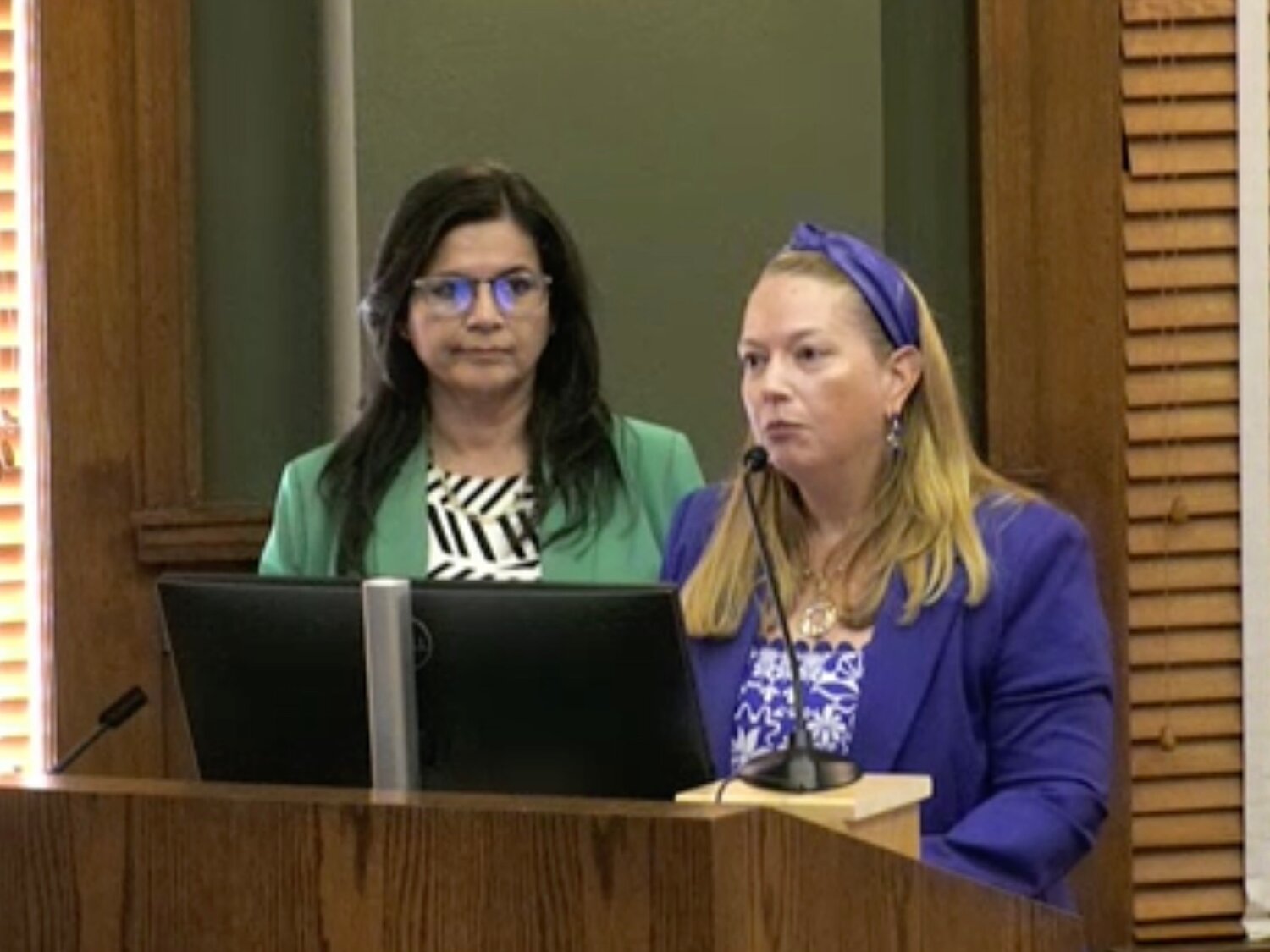
Good afternoon Judge Treviño, Commissioners Benavidez, and Commissioner Ruiz. As Mrs. Capitan said, my name is Heather Scott. I am a board member with Point Isabel ISD.
As you know, Point Isabel ISD encompasses the communities of Port Isabel, Laguna Vista, South Padre Island, Starbase, parts of Boca Chica, and the Port of Brownsville.
On March 10 of this year, Point Isabel ISD Board of Trustees held a public hearing and meeting, and unanimously voted to approve an application for taxable value limitation on eligible property filed by Saronic Technologies under the Texas Jobs Energy Technology and Innovation Act.
This marked one of the first steps in potentially solidifying Saronic’s interest in making a multi-billion dollar investment to construct and operate a large scale shipbuilding and maritime industrial facility at the Port of Brownsville.
Our board does not take lightly these types of requests from companies. And if we feel that a potential project is not beneficial to our community, our actions will reflect that, as we have done so in the past.
As to this project, our board clearly recognized the unique and multitude of opportunities that Saronic and Port Alpha would bring to the students and families of Point Isabel ISD, Cameron County, and this entire region, which is why our board fully supported this project.
Editor’s Note: The above remarks were made by Heather Scott, president of Point Isabel ISD, at a public hearing held by Cameron County Commissioners Court on June 2, 2026. The hearing was held to consider giving Saronic Technologies a tax abatement on a $3.2 billion shipyard and manufacturing hub project at the Port of Brownsville. No decision was taken by the commissioners.
 Teri Capistran, superintendent of Point Isabel ISD.
Editor's Note: Terri Capistran, superintendent of Point Isabel ISD, also gave testimony at Cameron County Commissioners Court's public hearing. Here is what she said:
I have been an educator for 37 years in this area, 30 of them in Brownsville, and seven currently at Point Isabel ISD. I was raised here, I live here, this is my home. So, when I speak, I'm speaking as a resident, and I'm speaking as an educator.
For years, in speaking with parents, I would hear the infamous brain drain, and someone referenced it earlier. And it was not because of the lack of amazing, talented students. It was a lack of opportunities for our students. For years, our students had to leave to get educated because the (Rio Grande) Valley did not have numerous opportunities for them. And we know what happens when they leave, many of them do not come back. But you know what, the educational landscape has changed.
Our community colleges have now added the trades, because we know that four years, six years, and eight years (of education) is not for everyone. And so the community colleges are now working with industry to ensure that there is an alignment. No different than what we're going to talk about right now, and I'm going to talk about: Saronic. But industry and community colleges are speaking. Someone referenced that's not happening. It absolutely is. That's called collective impact. Educators sitting with higher education, sitting with school districts, sitting with industry partners to ensure that what we are, our district… and I'll personalize it, what I am doing at my school district is aligned to ensure that our students are successful once they graduate.
And guess what, UTRGV has also changed its landscape. We now have a medical school, we now have opportunities that our students never had before. So, if our students choose to leave for higher education, that's a choice, not necessarily a need, because a lack of education that we have here. And our students are staying here, they're being educated here, and they're working here.
All of those alignments are critical to ensure that we have better for tomorrow. As parents, we want better. I'm a mama, but I'm also a grandma, and I want the very best for my two year old grandchild. On the industry side, our students in the Valley deserve the opportunities that students throughout the state have. Our students should not have to go to Austin, should not have to go to San Antonio, should not have to go to Dallas, because our Valley does not offer these opportunities here.
Do you know that in the Rio Grande Valley, in Region One (Education Service Center), which encompasses the entire Valley, that our students in our classrooms right now… the average of economically disadvantaged students is 85 percent? Eighty-five percent of our students sitting in classrooms right now are living in poverty. Do you know what the state average is? Sixty-three percent. Our students in the Rio Grande Valley are living at a much higher poverty level than students throughout the state.
So why am I here? I'm here as an educator that has taught, sat in the classroom with our students that have has taught parents, that has seen when our students are saying, Ma'am, I have to go because there's nothing here. Guess what, that is changing. Someone referenced earlier of opportunities that our students do have. I've been at those tables. I absolutely can tell you, industry wants to know, this is how we can align education in your classroom to ensure that your students are successful once they graduate. And again, four years, eight years, or one year, because our school districts are doing that through our college and career technical education programs.
We had a chance to visit Saronic, and I wanted to know, what are the working conditions like? Employees were happy, employees talked about how Saronic was changing their financial situations and for their families. So when we're speaking about families, we cannot disassociate and cannot separate the financial impact that is needed for a better future and to ensure that our kids have the same opportunity that everyone in the entire state has. Our students and families in the Rio Grande Valley deserve to have all of these opportunities. It is our moral obligation to do anything and everything that we can, including educating, but we can't just educate them if there are no jobs available for them. The two go hand in hand.
And let's continue talking. Education, meaning the school districts, community colleges, universities with industry to ensure that collectively we are making those right decisions. So, today I am speaking as an educator, as a mama, and as a grandma. When I speak about children, I'm speaking as I am about my own family, and do I want these opportunities available for my granddaughters? Absolutely, because I have seen firsthand the excitement when that project was happening, on the day that we were at (Saronic), and much excitement and joy of saying, ‘we did this.’
And then I wanted to know, okay, is what Saronic are talking about really happening in your families as an employee? Are they fulfilling? Absolutely. So, do our kids deserve these same opportunities, and to close that economic gap of 63 percent in the state, and over 80 percent of our students living in poverty? Absolutely, they do. So, I 100 percent support Saronic, and ask you to vote in favor, as an educator and as a community member, that together we want to move our Rio Grande Valley forward. Thank you.


