


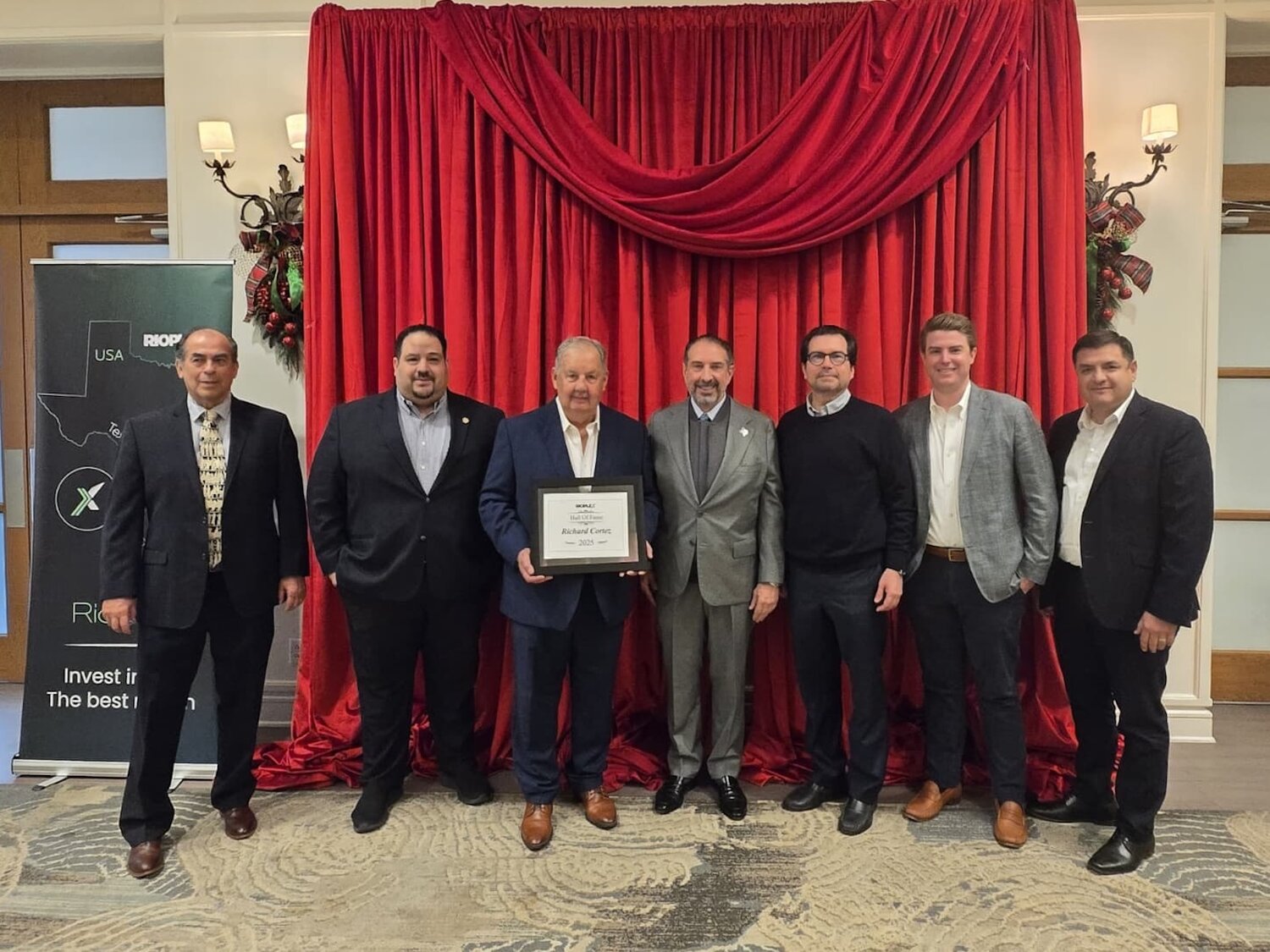
MCALLEN, Texas - How is RioPlex going to work with the numerous economic development organizations in the Rio Grande Valley?
How is the group going to ensure it does not duplicate the efforts of the EDOs when the State of Texas sends them potential leads?
These were two of the questions raised by Foreign Trade Zone No. 12 President Mark A. Garcia at a recent Leadership Gathering hosted by RioPlex at the McAllen Country Club. Garcia is a supporter of RioPlex.
“A lot of the leads are coming from the state. A lot of those leads go straight to the EDOs, individually. And they reply. How do we keep from duplicating?” Garcia asked.
“So RioPlex is going to reply to an RFI, and that local EDO for the municipality is also going to reply. How do we avoid that and how do you work with the local EDOs?”
RFI stands for Request for Information.

Two of the leaders in RioPlex responded to Garcia’s questions, along with Hidalgo County Judge Richard Cortez.
The first to provide answers was Mario Reyna, executive director of RioPlex. He said:
“We are communicating with them (the EDOs). Obviously, they all get the information. We communicate with them to let them know what we are doing. Obviously, a lot of times they would prefer to do the response and that is fine. For us, as long as someone is responding, that is all that matters at the end of the day.
“But we will give them the information that we have. Use if of you want. Maybe they have a better response than we do. But we can combine. Just like the Romans, we need to unite and respond to every RFI. If we don’t then Houston, Dallas, and San Antonio will get the deal.”
The next to offer a response to Garcia’s questions was Joaquin Spamer, chairman of the board of RioPlex. Spamer said:
“Look at it from the perspective of the prospect, of the investor. The more alternatives they have, the more attractive the region is. If we only have one single alternative, then, potentially there is only one broker available, or it is limited. But if you send ten different alternatives back and you have a response from the Port of Brownsville, from the EDOs, from RioPlex, from COSTEP, they are going to say, hey, I must go there because there are ten alternatives that I have to check.”
Spamer said the potential investor is more likely to make a trip to the RioPlex region if he or she has multiple responses to the RFI.
“On the same trip I am going to be able to evaluate all these different alternatives. So, that is very positive. What is very negative is if someone from Germany to receive ten different alternatives from Houston, ten from Dallas, ten from El Paso, and one from RioPlex. Where should I go? I am not going to waste time looking at one alternative. I might as well go to the different regions.”
Spamer said he agreed with Reyna’s remarks.
“There has to be a united effort, a joint effort. It is very important for everybody to be responsive, that we send our replies on time. We need to send as many alternatives as possible. Then we can spark the next step, which is for that one prospect, with a big investment, to say, you know what, I am going to spend a couple of days or a week in South Texas, in RioPlex, and I am going to see all the alternatives. I am going to go to the Port of Brownsville. And, hopefully, we are going to land more prospects.”
Then Judge Cortez, whose Prosperity Task led to the formation of RioPlex, offered his perspective.
“When we have the municipalities and they want to keep doing what they have been doing for ten years with no success… this is one of the reasons we have not been successful.”
Reyna responded to the judge’s remarks.
“We understand there is some sensitivity. But at the end of the day, what happens to the RFI? It (the development) is going to go to a city, and someone is going to build in their city. So, if was going to give you $1,000, would you deny it? No. That is what we are doing with RioPlex. We are promoting the region, companies are going to come here, but they are not going to come to us, to RioPlex, they are going to go to a city. So, if I am an EDO, I would say, hey, fantastic guys, keep doing what you are doing. Everybody will look good at the end.”
Later in the conversation, architect Laura Warren spoke about her dealings with foreign investors. She said it is important to know what land is available and whether sufficient water and electricity will be available for projects on that land.
Reyna said RioPlex had a proposal that would have required enough electricity to power 369,000 homes. “Obviously we did not play with that one,” he said.
Judge Cortez said Hidalgo County is working to address shortages to key resources.
“We are working for more power. We are working for more water. That is why we are working as a region. It will give us more attention from the governor, as a region. Because that is what we are.”
Cortez then brought up the subject of mobility.
“We need to allow science to help us solve mobility issues, not politics. I do not want a strong mayor to win over a weak mayor just because he is smarter or better. I want science to put the road where it should go. We are working on all those things.
“But what is important here to me is, we are looking for success. So, what is our approach? We are using the mall theory. Our mall is RioPlex. What do we find in RioPlex? Everything we find in RioPlex we want to define as quantifiable information so that regardless of who wants to know about us, we have all the relevant information.
“When you go to the mall, there are different stores in the mall. Each store in the mall, you advertise the store. We cannot be a good mall if we do not have good stores. In that case we don’t have a partnership. The better you (the cities) are, the better our mall is going to be. That is all we are asking you. To be part of that mall. And you are going to get a chance when we bring a customer here, you are going to get a bite of the apple.
“I think your success will be better than if you are one star in the galaxy and you try and impress somebody that has all those other markets to look at.”
Cortez concluded: “I think we are going in the right direction. And I hope you understand that. Economic development is simple. What do we want and how are we going to get it? No. 2, where do we find it? No. 3, what do we have to do to convince them to come?
“This (RioPlex project) has been long overdue. We are not selling any county. We are not selling any city. We are selling RioPlex. And I am going to tell you with a lot of confidence; we are going to do a lot better in the future.”
Cortez won applause for his remarks.


