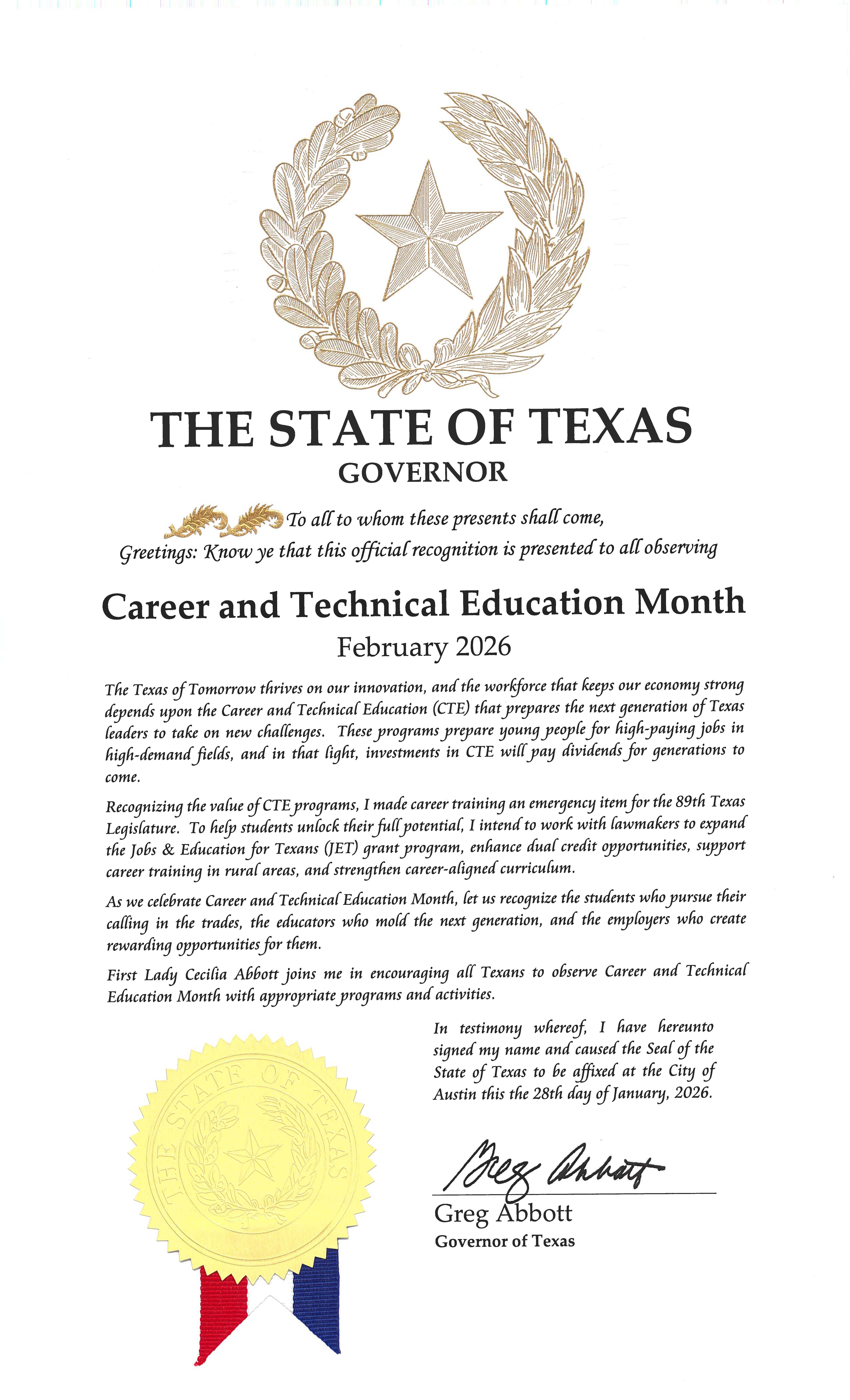
February is Career and Technical Education (CTE) Month, and it’s incredibly important to highlight the value of CTE programs across the state, as well as the opportunities that await students who pursue high-skill technical careers.
As employers in Texas continue to outpace the nation in job creation, our state is consistently recognized as the best state in the nation for doing business. This growth is one of the reasons Texas continues to attract businesses from across the globe in industries of critical importance to our economic security, such as aerospace, semiconductors, advanced manufacturing, life sciences, and more. While employers consider relocating or expanding in Texas, our support for career and technical education programs must stay ahead of the curve to fill in-demand occupations.
The fact is: employers go where the skilled workers are.
When CEOs evaluate where to grow, they aren’t just choosing a location – they’re choosing a workforce. We know that for many employers, the challenge isn’t just a worker shortage. It’s a skills shortage.
By 2031, more than 60% of jobs in Texas will require education or training beyond a high school diploma, according to a report from Georgetown University. However, fewer than 40% of Texas students are attaining a degree or workforce training within six years of graduating high school.
In just the past year, there were 1.4 million unique job postings across Texas for skilled trades from more than 80,000 different employers — a 13.4% increase over the previous year.
These aren’t abstract numbers. They represent real demand for welders, electricians, engineering technologists, and mechanics – all of which are occupations that often rely on career and technical education programs to produce skilled, credentialed workers.
As Jim Farley, CEO of Ford Motor Company, has advocated, we need a new mindset that recognizes the success and importance of the essential economy — everything that needs to be moved, built, or fixed.
Take data centers and AI infrastructure, for example. As artificial intelligence continues to grow, we’ll see rising demand for skilled trades — people who can build, wire, and maintain the massive data facilities that make all that computing power possible.
A revitalized focus on trades isn’t just good for the economy; it opens a wealth of opportunity for our communities. Students who enroll in CTE courses are more likely to graduate high school, enroll in a two-year college, be employed after high school, and earn more in the year after high school, according to a report from Texas 2036. The Labor Market Information Institute also found that workers in Texas with a certification earn $356 more per week than their counterparts without a certification.
In our state we have elected leaders who support this mission and understand that investing in the workforce of the future is an investment in the prosperity of Texas. At the State of the State Address in 2025, Gov. Greg Abbott designated career training as an emergency item for the 89th Legislative Session — a mission TWC is committed to delivering.
One of our top priorities at TWC is making sure Texans have the skills, credentials, and training needed to compete for these high-demand jobs. That means expanding partnerships between employers, education, and workforce boards; promoting work-based learning opportunities like internships and apprenticeships; and supporting career and technical education programs.
We do this through training programs, like the Jobs and Education for Texans (JET) grant. The JET grant directly supports CTE programs, providing funding to equip high school and college training labs with cutting-edge technology so students are trained with the tools they will actually use in their career.
Over the past two years, more than $29 million in JET grants have been awarded to train more than 13,000 students, and for the first time in the JET program’s history, a community college — Grayson College — used JET funds for training in semiconductor manufacturing, ensuring Texas remains ahead of the curve in this globally competitive industry.
My message to students — become part of this essential economy. You’ll find good-paying jobs are ready and waiting.
To employers — you must continue building bridges between education and industry and aligning curriculum with real employer demand, so Texans aren’t just earning credentials, but credentials that matter in the labor market.
The truth today is that CTE is one of the most powerful tools to achieve career success and prosperity. TWC remains working with partners in education, economic development, and industry, to support programs like JET, among others. When we build pathways to good-paying jobs, we’re building economic security for families, and a stronger Texas.
Editor’s Note: The above commentary was provided by Joe Esparza, Texas Workforce Commission Chairman and Commissioner Representing Employers. The commentary appears in the RGG Business Journal with the permission of the author.