


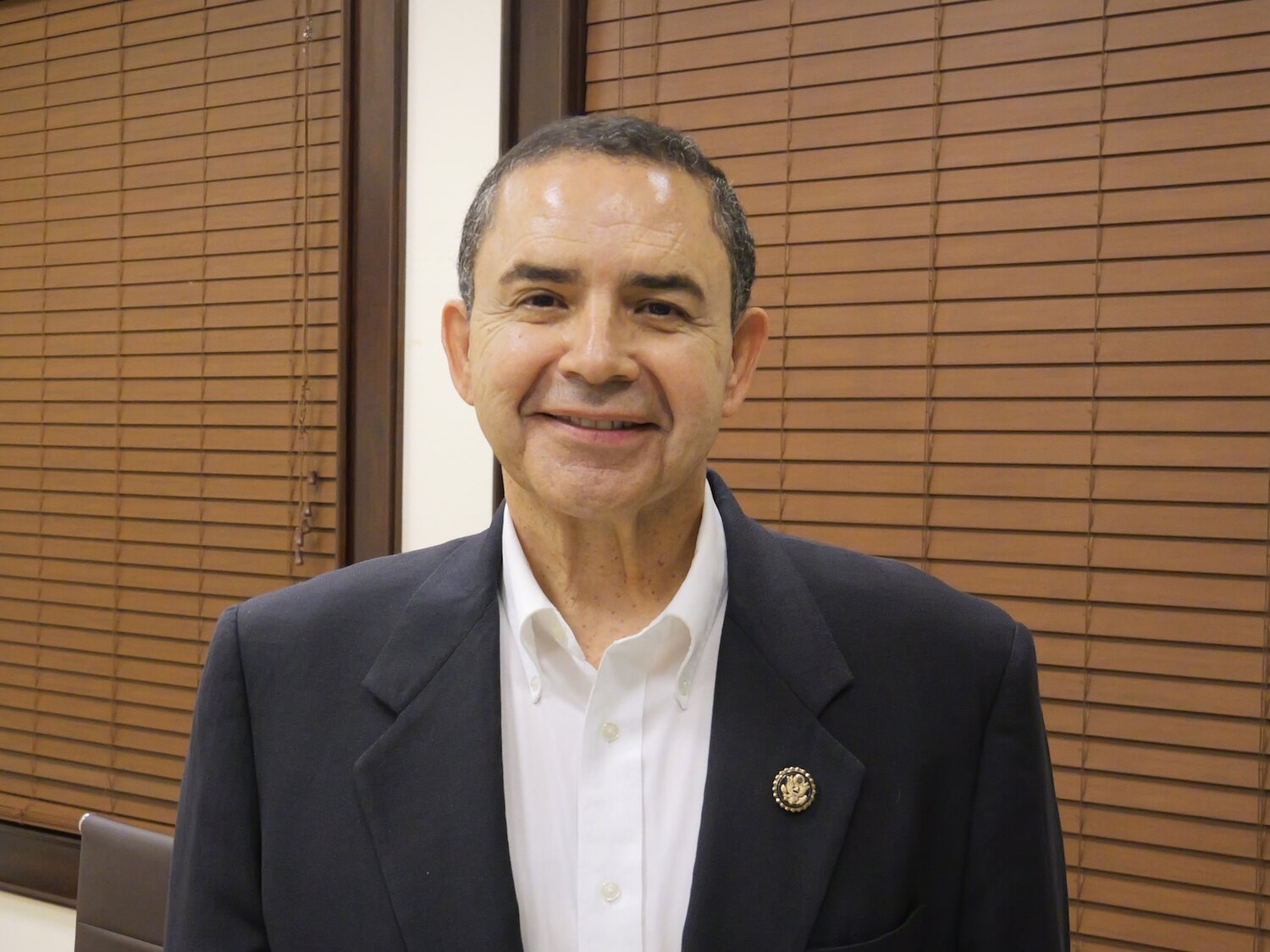
LAREDO, Texas — U.S. Representative Henry Cuellar is warning that the federal government's decision to shift the United States-Mexico-Canada Agreement (USMCA) into a volatile cycle of annual reviews rather than issuing a long-term extension has caused multi-million dollar cross-border investments to completely freeze across South Texas ports of entry.
Cuellar, a veteran Laredo Democrat who is also a licensed customs broker, stated that the move away from regulatory predictability is already severely disrupting operations for customs brokers, warehouse operators, and transportation providers along the entire length of the Texas-Mexico border.
"The president cannot terminate this agreement. It just goes into annual reviews until 2036," Cuellar said, in response to questions about USMCA from the Rio Grande Guardian Business Journal during a Zoom call with news reporters.
"What that does, it injects an element of uncertainty. So you’ve got the tariffs that have brought the cost of things up. Then you have the uncertainty of the trade agreement: is it going to move or not?"
The shifting trade landscape follows the formal transition of the landmark accord into high-stakes annual reviews. While the trade pact technically remains in force until its potential expiration in 2036, the lack of a clean 16-year renewal has rattled regional commerce authorities.
According to Cuellar, the economic paralysis is visible throughout the border region, extending from the largest inland port in Laredo down through the Rio Grande Valley and out toward West Texas.
"I've heard from experts and from people on the ground—customs brokers, warehouse owners, transportation. They all said that the investment has stopped. Even business people from Mexico... I've had chamber leaders here in my office. They said 'we don't know what to do. We don't know what the U.S. wants to do.' And that just stops the investments in the Rio Grande Valley, in Laredo, in El Paso, Brownsville, and other places like Eagle Pass."
The depth of frustration felt by logistics stakeholders was highly visible during a major international trade show held recently in Laredo, organized jointly by the City of Laredo and the Laredo international bridges system. While legislative duties kept Cuellar in Washington, D.C., his office received extensive feedback from the trade experts, international delegates, and operators attending the event.
Cuellar noted that the overwhelming sentiment among attendees was one of profound disappointment over the administration’s handling of North American commerce rules.
The current gridlock stands in sharp contrast to the massive bipartisan momentum that carried the USMCA into law six years ago. Cuellar recalls the historic legislative passage of the pact with immense pride, maintaining a piece of that history in his congressional office.
"If you ever come to my office, anybody, you'll see the gavel. I was presiding as a speaker pro tempore when the USMCA was passed. I have the gavel for the USMCA," Cuellar said. "It was passed strongly, and when it passed, President Trump said it was the best trade agreement in the history of the world. And here we are dealing with the best trade agreement in the history of the world. We’ve just got to get rid of the tariffs. We’ve got to get that trade agreement revised again between the U.S. and Mexico."
Border leaders stress that securing a stable framework is vital to maintaining these supply lines. Cuellar emphasized that while border economies in Laredo, Eagle Pass, and the Rio Grande Valley continue to show immediate resilience, the true potential of the region is being artificially capped by volatile federal policies. He emphasized that the region "can do much better if we get this trade agreement back again."
Beyond trade regulations, Cuellar pointed out that the logistics and industrial landscape along the border is facing a multi-front crisis. He noted that localized construction projects and critical warehouse developments have ground to a near-halt, heavily impacted by an aggressive wave of enforcement actions by Immigration and Customs Enforcement (ICE).
"We’ve got to get rid of the tariffs and we stop the ICE raids because anybody that's seen the construction industry, the warehouses, have pretty much stopped because of the ICE raids," Cuellar concluded.


