



MISSION, Texas - A new report commissioned by the Council for South Texas Economic Progress makes the case for a unified Metropolitan Statistical Area for the entire Rio Grande Valley.
Currently, the Valley has two MSAs: McAllen-Edinburg-Mission, which incorporates all of Hidalgo County, and Brownsville-Harlingen, which includes all of Cameron County.
If the four-county Valley was redefined as one MSA it would rank 42nd nationally, with a population of 1,479,873.
The regional Gross Domestic Product (GDP) would be $40.9 billion, the report states. The total civilian labor force would be 657,962. The regional unemployment rate would be 6.5 percent. The average median household income, population-weighted, would be $54,771, and the poverty rate would be 26.6 percent.
The report was produced for COSTEP by Allied Consulting Group.
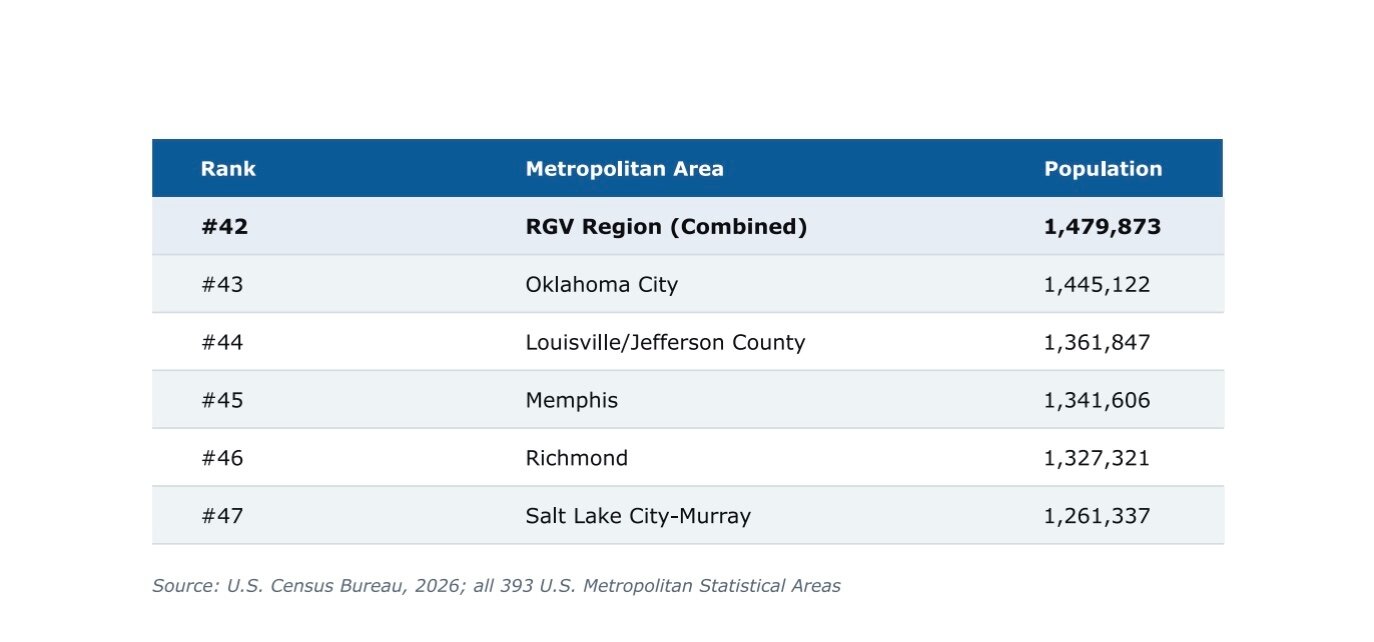 A table from COSTEP's "Rio Grande Valley Regional MSA Economic Report."
According to Wikipedia, an MSA is “a geographical region with a relatively high population density at its core and close economic ties throughout the region.”
Wikipedia points out that MSAs are defined by the Office of Management and Budget, which is part of the Executive Office of the President. MSAs are used by the U.S. Census Bureau and other federal government agencies for statistical purposes.
COSTEP’s new report covers 24 pages. Its executive summary states:
“The Rio Grande Valley - comprising Hidalgo, Cameron, Starr and Willacy counties - forms an economically interconnected region. When analyzed as a unified metropolitan area, the region's combined indicators reveal a significant economic engine comparable to recognized MSA across the United States. With a combined population of 1,479,873, the Rio Grande Valley would rank No. 42 among 393 US metropolitan statistical areas, on par with Louisville, Memphis, and Richmond.”
In the report, the case is made for a unified MSA.
“Individually, each county in the Rio Grande Valley is too small to attract the attention of national economic development programs, site selectors, and federal funding formulas that reference MSA level data. However, when viewed as a single economic region, the Rio Grande Valley is a top 50 metropolitan area in the United States,” the report states.
The populations range of the four counties range from 21,523, in the case of Willacy, to 937,784 for Hidalgo.
“None would rank in the top 60 metros alone, but combined the Rio Grande Valley's 1,479,873 residents would place it at number 42 nationally, directly alongside established metro areas such as Louisville, Memphis, and Richmond.”
GDP per capita provides a measure of economic productivity relative to population size. “While the Rio Grande Valley’s aggregate GDP is competitive, per-capita output reveals significant room for growth - and the transformative potential of targeted investment,” the report states.
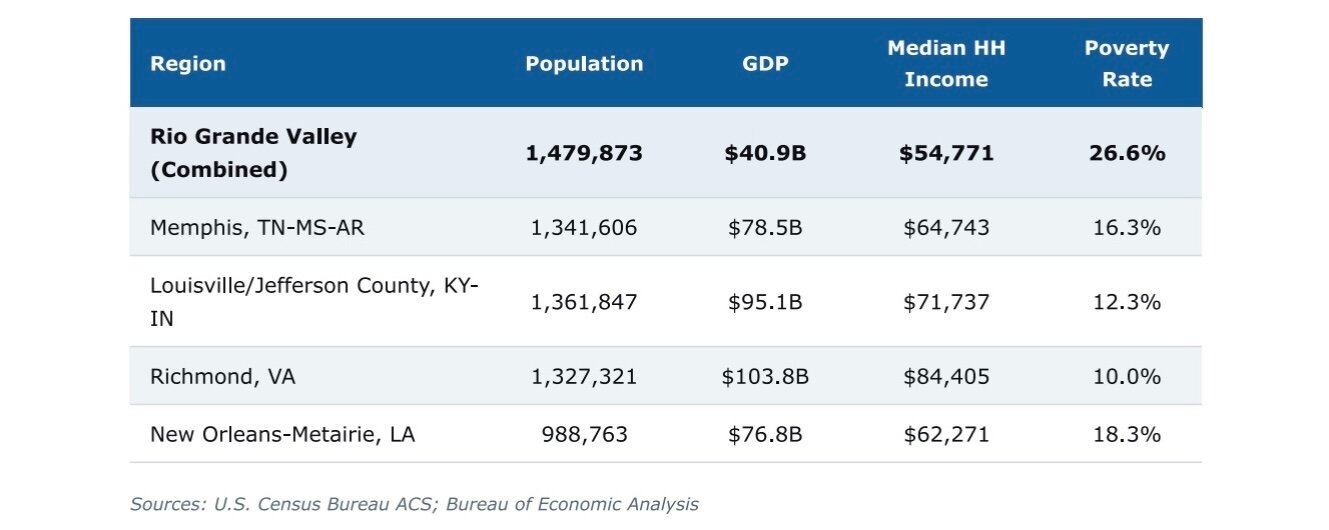
Comparing the combined Rio Grande Valley region to established MSAs of similar size “provides context for the region’s economic standing,” the COSTEP report states.
“The peer MSAs selected - Memphis, Louisville, Richmond, and New Orleans - represent comparable regional economies that rank near the Rio Grande Valley’s No. 42 position nationally.”

In addition to making the case for a unified region for population and demographic analysis, the COSTEP report features comprehensive data across 12 core sections. These include housing, migration, commuting patterns, economic indicators, employment, international trade and border crossings, higher education pipeline infrastructure assets, regional economic activity and a peer MSA comparison benchmark.
There has long been discussion about the Valley’s two MSAs merging. Back in the early 2000s, the Rio Grande Valley Partnership, under the leadership of Bill Summers, explored the idea. Indeed, Summers wanted to see a unified MSA in the Valley that also featured northern Tamaulipas.
“The Valley and Northern Mexico were seriously considered for classification as one Metroplex back around the year 2000,” said David Allen, a former RGVP vice president from Weslaco who is now retired.
“There was a task force created by the RGV Partnership. Bill Summers was President and I was his VP. What we learned at that time was that there was a lot of interest but there was always a bit of tension and jealousy between the Hidalgo County cities and the Cameron County cities. (It was about) who was the bigger economic power and, therefore, who should control the naming of the Metroplex as well as who would spearhead the process.”
Allen continued: “As a result of the ‘Valley leaders’ acting that way at that time, the idea was pushed aside … with the hopes of it rising up in the future. Hopefully, this is an opportunity now, in which ‘Valley leaders’ can put aside their differences and focus on what this designation will mean for the entire RGV.”
In an op-ed for the RGG Business Journal three months ago, Mario Reyna, coordinator of the Hidalgo County Prosperity Task Force, said combining the Valley with northern Tamaulipas as a united MSA would mean a binational RioPlex economy would be an estimated $85–90 billion. And its population would be an estimated 3.5 million.
However, Reyna said the United States does not recognize binational MSAs.
‘The United States does not officially recognize binational MSAs, so this comparison is conceptual. However, the economic and population scale of the RioPlex region is real,’ Reyna wrote. “In terms of population, a 3.5-million-person market would rank among the larger metropolitan regions in the United States.”


