



Last month, I shared how our partnership with Omni Fiber is helping build the physical foundation for a more connected Brownsville.
This month, I want to talk about something people rarely associate with technology leadership.
Money.
Not budgets.
Not cost reductions.
Not procurement.
I'm talking about learning how to bring new money into your organization.
Because after several years as a CIO, I've come to believe something that isn't taught in most technology leadership books:
One of the most valuable skills a CIO can develop is learning how to secure grant funding.
The Skill Nobody Warns You About
When I became CIO, I had a vision for where Brownsville could go.
I wanted to modernize our infrastructure, improve cybersecurity, improve connectivity, implement a service management system, invest in AI, and create a stronger digital foundation for every department.
There was just one problem.
The budget wasn't large enough to do everything we wanted.
I realized pretty quickly that if I waited for the annual budget cycle, many of those projects would never happen.
So I had to learn a completely different skill.
I became a grant writer.
Not because I wanted to...
Because I had to.
My Biggest Mistake
At first, I thought writing grants meant filling out applications.
I couldn't have been more wrong.
My early submissions weren't successful because I was trying to write grants before I had built projects.
Eventually, I realized something that changed everything.
A winning grant application isn't an application.
It's the final chapter of a well-designed project.
Long before anyone asks for paperwork, you need a clear vision, executive support, stakeholder alignment, measurable outcomes, realistic budgets, and a roadmap that proves you know exactly where you're going.
Once we started doing that work first, the funding started following.
People often ask where cities find money for technology initiatives.
The reality is that opportunities exist at every level.
State lobbyists regularly distribute information on new grant programs.
Federal agencies like FEMA and NTIA invest heavily in technology and infrastructure initiatives.
Cybersecurity programs such as the State and Local Cybersecurity Grant Program (SLCGP), administered through the Center for Internet Security, help communities strengthen their security posture.
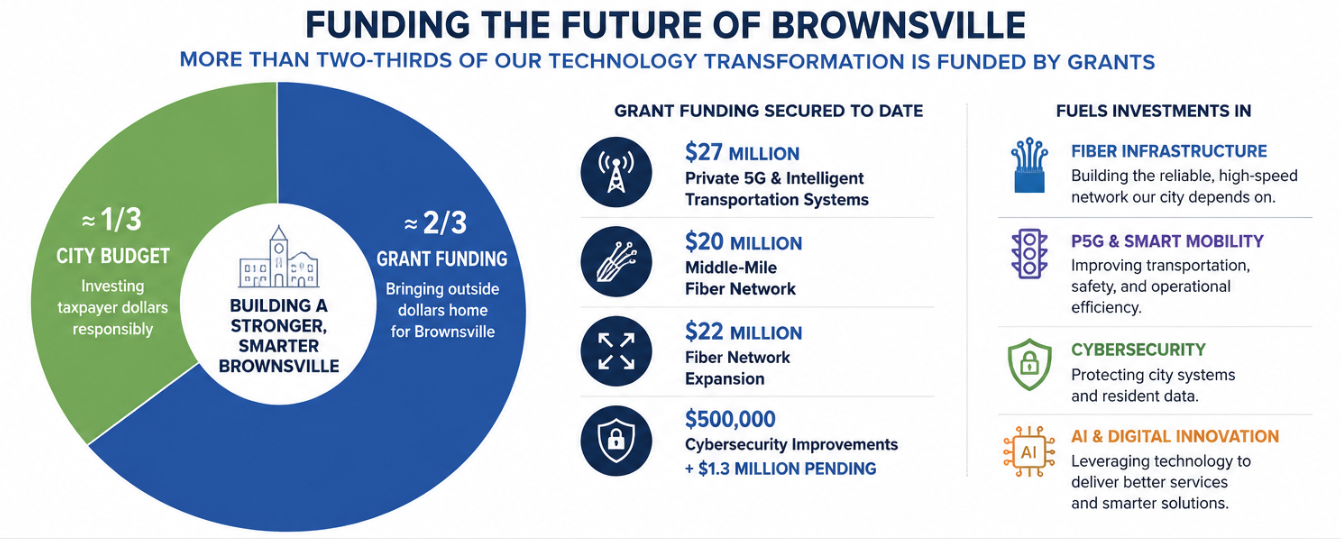
For Brownsville, that approach has helped secure funding for projects including:
Today, more than two-thirds of the technology transformation taking place across Brownsville is being funded through grants rather than relying solely on taxpayer dollars.
That didn't happen by accident.
It happened because we learned how to compete for funding.
Five Lessons That Improved Our Odds
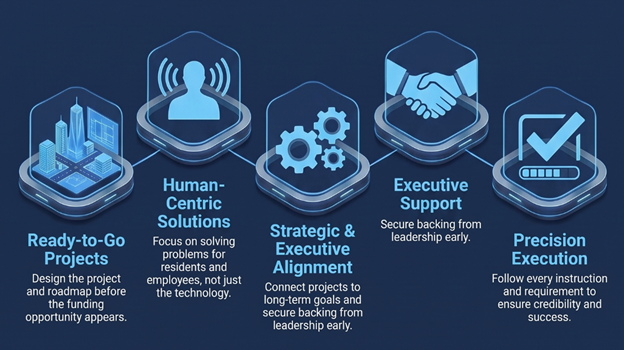
If you're beginning your own grant journey, here are the lessons I wish someone had shared with me.
1. Build the project before the grant. A funding announcement should never be the beginning of your planning. Have your project designed before the opportunity appears.
2. Solve a human problem. Technology isn't the story. People are. Explain how residents, employees, or first responders will benefit.
3. Connect the project to your strategy. The strongest proposals don't feel isolated. They support long-term city goals and existing strategic priorities.
4. Build support early. Projects backed by department leaders, elected officials, and community partners carry far more credibility.
5. Follow every instruction. Many grants are lost because applicants skip requirements or overlook small details. Great ideas still have to follow the rules.
The Real Lesson
Looking back, I don't think grant writing is really about writing grants.
It's about leadership.
Leaders don't wait for perfect budgets.
They build partnerships.
They create vision.
They align people.
And when the resources don't exist, they find a way to bring them in.
Technology leaders today have to be more than technologists.
We have to be strategists, communicators, relationship builders, and sometimes fundraisers.
Because innovation doesn't begin when the money arrives.
The money usually arrives after someone has already done the work to create a vision worth investing in.
Thank you for reading this month's edition of Brownsville Connected.
If you're a CIO or technology leader working through similar challenges, I'd be happy to share more about our approach to building projects, developing grant strategies, and creating momentum with limited resources.
Sometimes the biggest technology breakthrough isn't a new platform.
It's learning how to fund the future before everyone else sees it.
Jorge Cardenas, Chief Information Officer, City of Brownsville
Editor’s Note: The above commentary was penned by Jorge Cardenas, chief information officer for the City of Brownsville. It first appeared on the author’s social media pages. The commentary appears in the RGG Business Journal with the permission of the author.


